
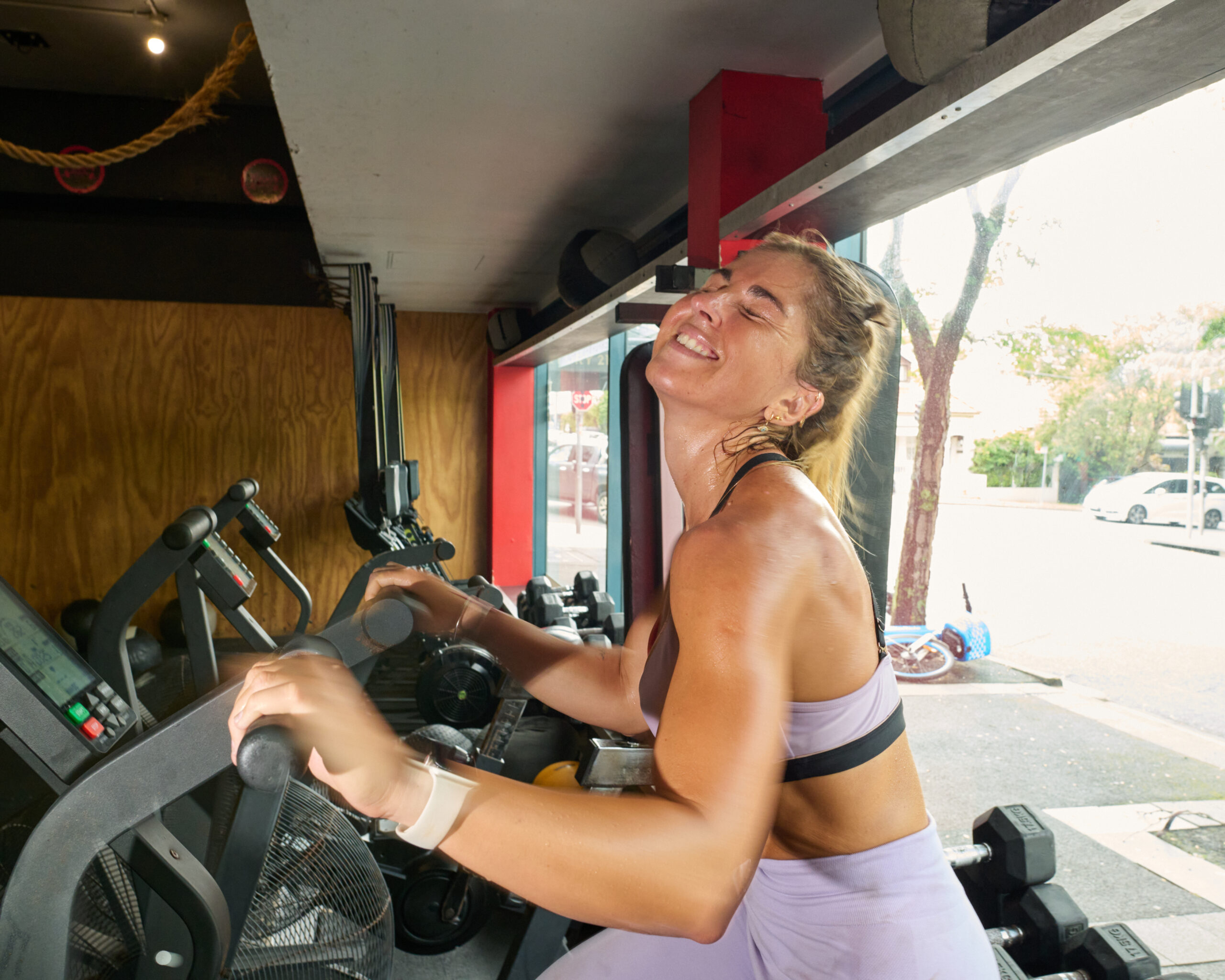
CrossFit for beginners can look intimidating. If you’ve watched a CrossFit class before, we understand why you might wonder whether you need to get fitter before giving it a try.
You might see someone lifting a heavy barbell while another person is doing pull-ups. The music is going, people are breathing hard and there might be a workout counting down on the clock.
From the outside, CrossFit can look intense.
And it can be.
But there is an important part of CrossFit that isn’t nearly as obvious from watching an experienced athlete train:
Intensity is relative to the person doing the workout.
Someone walking into CrossFit Bondi for their first session should not be expected to train at the same load, volume, pace or movement complexity as someone who has spent five years developing their fitness.
In fact, properly coached CrossFit works in almost the opposite direction.
You learn first.
You build consistency second.
And intensity develops as your capacity improves.
So if you’re thinking about trying CrossFit in Bondi Junction but you’re worried that you’re not fit enough, strong enough or experienced enough to start, here’s what you should actually know.
You Don’t Need to Get Fit Before Starting CrossFit
This is probably the biggest misconception we hear from beginners:
“I’ll get a little fitter first, then I’ll try CrossFit.”
But getting fit before starting CrossFit is a little like saying you need to learn to swim before taking swimming lessons.
Training is the process that develops your fitness.
CrossFit was designed around developing broad physical capacity rather than requiring you to arrive with it already established. The methodology combines areas such as cardiovascular conditioning, strength training, gymnastics and weightlifting to develop qualities including endurance, stamina, strength, flexibility, power, coordination, agility, balance and accuracy.
That doesn’t mean a beginner immediately starts performing every CrossFit movement.
It means the training can progress toward those movements over time.
You might begin with an air squat rather than a heavy barbell squat.
You might perform ring rows rather than pull-ups.
You might step onto a box rather than jump onto it.
You might use a light kettlebell instead of a heavy barbell.
The movement changes.
The load changes.
The number of repetitions can change.
But you’re still training toward the same underlying physical capacity.
That’s scaling, and it is one of the most important concepts for anyone considering CrossFit for the first time.
What Does Scaling Mean in CrossFit?
Every CrossFit workout has an intended training stimulus.
The goal of scaling isn’t simply to make a difficult workout “easy.”
It’s to find the version of that workout that provides an appropriate challenge for you.
A coach can modify variables including:
- the weight you lift
- the movement you perform
- the number of repetitions
- the total workout volume
- the distance you run or row
- the height of a box or target
- the complexity of a gymnastics movement
- your pace and overall intensity.
For example, imagine today’s workout contains pull-ups.
One experienced athlete might perform chest-to-bar pull-ups.
Another might perform regular pull-ups.
A newer member might use a band.
Someone else might perform ring rows.
They can all train beside one another while working on an appropriate version of the same movement pattern.
CrossFit Marrickville describes scaling similarly: changing weights, movements, repetitions, duration or intensity while trying to preserve the purpose of the workout.
That’s why looking at the most experienced person in a CrossFit class doesn’t tell you what your workout would look like.
CrossFit Doesn’t Actually Say “Intensity First”
This is where the public perception of CrossFit and good CrossFit coaching can be very different.
Yes, intensity is an important part of CrossFit.
But CrossFit’s coaching framework isn’t:
Intensity → more intensity → try not to die.
It’s:
Mechanics → Consistency → Intensity
CrossFit describes mechanics as learning to perform a movement correctly and efficiently. Only once an athlete develops those mechanics should the focus move toward performing them consistently. Greater intensity is then progressively introduced when the athlete has developed sufficient competency.
For a beginner, this matters enormously.
Your first goal isn’t to finish first.
It isn’t to lift the heaviest weight.
And it definitely isn’t to keep up with the person beside you.
Your goal is to learn.
A good coach wants to see how you squat, hinge, push, pull, brace, jump, run and move before deciding how much difficulty to add.
Over time, as those movements become more familiar and your fitness develops, we can gradually ask more from you.
That might mean a little more weight.
A few more repetitions.
A slightly faster pace.
Or eventually progressing to a more technically demanding movement.
CrossFit’s own current guidance describes this process as a blueprint for long-term, sustainable development rather than chasing intensity at the expense of movement quality.
So Why Do CrossFit Workouts Look So Hard?
Because for an experienced athlete, they can be.
That’s part of what makes CrossFit effective and rewarding.
But there’s a big distinction between:
“This workout is challenging.”
and
“This workout is inappropriate for me.”
Good coaching aims for the first while avoiding the second.
Imagine two people are running together.
One is an experienced runner holding a 4:30/km pace.
The other has just started running and is holding 7:00/km.
Both might be experiencing a similarly challenging effort relative to their individual fitness.
CrossFit works on a similar principle.
The fitter you become, the more you’re capable of doing.
The workout grows with you.
What Happens If I Can’t Do Pull-Ups, Handstands or Olympic Lifts?
Then you join a very large club of people who couldn’t do them when they started.
CrossFit uses movements drawn from several different areas of physical training, including squatting, pressing, deadlifting, Olympic weightlifting, running, rowing and gymnastics.
Some are simple.
Some take months to learn.
Some can take years to master.
And that’s okay.
You don’t need a muscle-up to benefit from learning how to pull.
You don’t need to walk on your hands to develop shoulder strength.
And you don’t need a technically perfect snatch before you’re allowed to touch a barbell.
Good coaching uses progressions.
Take the squat as an example.
A beginner might start by learning an air squat.
Later that can progress to a goblet squat.
Then perhaps a front squat.
Eventually, greater loads and more complex variations can be introduced.
CrossFit itself uses the air squat as an example of a foundational movement whose principles carry over into more advanced squat variations.
You’re not expected to skip the learning process.
The learning process is the training.
What Should the First Few Weeks of CrossFit for Beginners Look Like?
Not like you’re trying to qualify for the CrossFit Games.
Your early training should be about understanding the environment and establishing foundations.
You’ll start learning things like how to squat and hinge properly, how different equipment works, how workouts are structured, what different movements mean and what an appropriate pace feels like.
You’ll also start learning something extremely valuable:
your own capacity.
Perhaps you discover you’re stronger than you expected but cardiovascular conditioning is difficult.
Someone else might have excellent endurance but little experience lifting weights.
Another person might be mobile and coordinated but hasn’t exercised consistently for ten years.
There is no requirement for everyone to start at the same point.
That’s exactly why coaching matters.
Will I Be the Least Fit Person in the Class?
Maybe.
Someone has to be.
But here’s the thing people often don’t realise until they actually experience a good CrossFit gym:
most people aren’t paying attention to how fit you are.
They’re busy doing their own workout.
One person might be trying to complete their first pull-up while the person beside them is working toward ten.
Someone might be lifting an empty barbell while someone else is lifting 100kg.
They’re different achievements.
CrossFit group training grew partly around the motivational benefits of training alongside other people. Early CrossFit writing specifically highlighted the camaraderie and social dynamic created by group classes, while also emphasising that professional coaching standards still require individual attention within that group environment.
That’s an important distinction.
Group training shouldn’t mean generic training.
The class trains together.
The coach still coaches the individual.
What If I Haven’t Exercised in Years?
Then we’d rather know that than have you pretend otherwise.
Your training should reflect your current capacity, not the fitness level you had five or ten years ago.
For someone returning after a long period away from exercise, that might mean reducing workout volume substantially, using lighter loads and allowing more recovery while your body adapts.
CrossFit’s Level 1 material specifically states that intensity and volume should be scaled for beginners and gradually increased as the athlete progresses.
There is no prize for doing too much in week one.
We’d much rather see you train appropriately, recover, come back and gradually string together weeks and months of consistent training.
Because that’s where fitness is actually built.
How Often Should a Beginner Do CrossFit?
There’s no universal number that works for everybody.
For many beginners, three sessions per week is a very sensible starting point.
That provides enough exposure to start learning movements and developing fitness while still giving your body time to adapt.
As your capacity, training history and recovery improve, that frequency can change.
What matters more initially isn’t trying to train every day.
It’s establishing something sustainable.
Three sessions every week for six months will usually teach you considerably more about training than smashing yourself six times in week one and disappearing for the next three weeks.
Consistency beats enthusiasm without structure.
Is CrossFit for Beginners Safe?
No physical training is completely risk-free.
Running has injury risk. Field sports have injury risk. Strength training has injury risk. So does CrossFit.
The better question is:
How should CrossFit be coached to manage that risk while still producing meaningful fitness?
This brings us back to mechanics, consistency and intensity.
CrossFit’s current guidance explicitly states that sound mechanics should precede greater load, speed and volume, with coaches managing intensity according to the individual athlete.
That’s also why coaching matters more than simply copying a workout from the internet.
A written workout doesn’t know your training history.
It can’t see how you’re moving.
And it can’t tell you when 40kg should actually be 20kg today.
A coach can.
What CrossFit Beginners Should Understand Before Starting
If you’re considering starting CrossFit in Bondi Junction, our Getting Started at CrossFit Bondi guide explains how we introduce new members to training, including scaled workouts and coached foundations.
You don’t need to impress us.
You don’t need to know CrossFit terminology.
You don’t need to lift heavy weights.
You don’t need to be able to do pull-ups.
And you absolutely don’t need to get fit before you arrive.
What we want is much simpler.
Come in willing to learn.
We’ll meet you at your current level, teach you the movements, adjust the training where necessary and progressively build from there.
Eventually, the things that looked intimidating when you first walked through the door have a funny way of becoming normal.
The empty bar becomes loaded.
The ring row becomes a pull-up.
The walk/run becomes a run.
And the workout that once looked impossible becomes something you know how to approach.
Not overnight.
Through training.
Frequently Asked Questions About Starting CrossFit
Is CrossFit good for complete beginners?
Yes. CrossFit workouts can be modified according to an individual’s current strength, conditioning, movement competency and training experience. Beginners should focus on learning sound movement mechanics and developing consistency before progressively increasing intensity.
Do I need to be fit before starting CrossFit?
No. You train to become fitter. Your workouts should initially be scaled to your current ability and progressively become more challenging as your capacity improves.
What happens if I can’t do a movement?
Your coach can provide an appropriate progression or alternative. Pull-ups might become ring rows, box jumps might become step-ups and barbell loads can be reduced while you learn the movement.
Is CrossFit too intense if I haven’t exercised for years?
It shouldn’t be. Intensity, volume, loading and movement complexity can all be adjusted. Someone returning to exercise after several years should generally begin conservatively and progressively build their training capacity.
How many times per week should a CrossFit beginner train?
For many beginners, around three sessions per week provides a practical starting point, although the appropriate frequency depends on training history, recovery, goals and other physical activity.
Where can I try beginner CrossFit in Bondi?
CrossFit Bondi is located in Bondi Junction in Sydney’s Eastern Suburbs. Our coaches can modify CrossFit sessions for different training backgrounds and ability levels, including people completely new to CrossFit.
You Don’t Get Fit Enough to Start. You Start to Get Fitter.
If CrossFit looks intimidating from the outside, we understand.
You’re seeing people at different stages of a journey without seeing the months or years of training that got them there.
The person doing muscle-ups once couldn’t do one.
The person lifting the heavy barbell once lifted an empty one.
And the person moving confidently through the workout once walked into their first CrossFit class wondering exactly what you’re wondering now:
“Am I fit enough for this?”
You don’t have to prove that you belong before you start.
Starting is how you build the capacity to do more.
At CrossFit Bondi in Bondi Junction, we’ll meet you where you are and build from there.
Ready to see what CrossFit actually feels like?
You don’t need to commit to a membership or arrive fit. Book a free CrossFit trial and our coaches will scale the session to your current ability.